
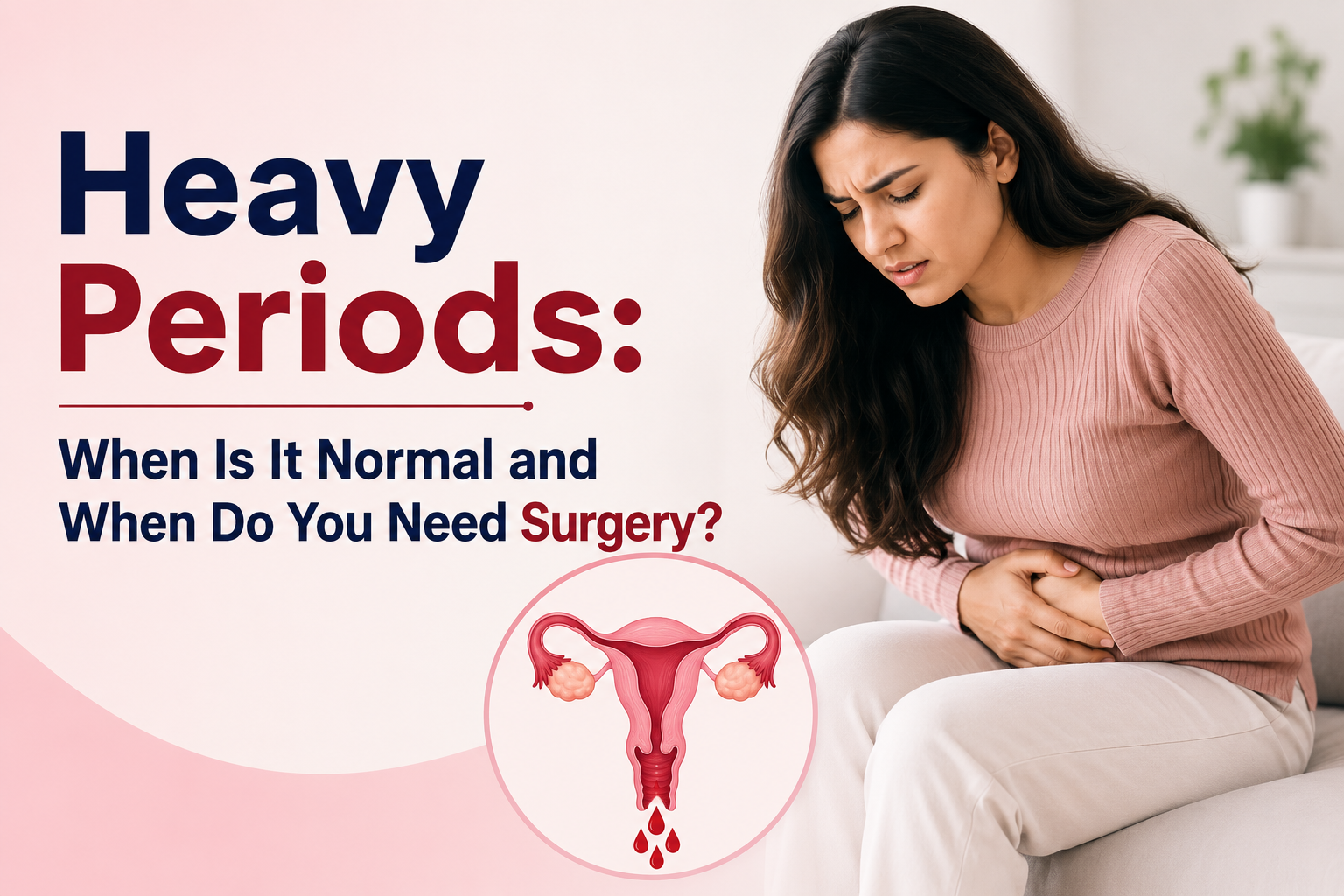
Every woman has a different experience of menstruation. Some have light, predictable cycles. Others bleed heavily, pass clots, and are confined to their homes for several days each month. But where is the line between ‘heavy’ and ‘medically significant’? And when does heavy bleeding require surgery? Dr. Shweta Mendiratta, gynaecologist and minimal-access surgeon in Faridabad, provides the definitive guide.
What Counts as Heavy Bleeding?
Medically, heavy menstrual bleeding (menorrhagia) is defined as blood loss of more than 80 ml per cycle — roughly equivalent to filling more than 16 fully soaked regular pads. But measuring blood loss in ml is impractical, so clinically, heavy bleeding is defined as bleeding that:
- Requires changing a pad or tampon every 1–2 hours
- Lasts longer than 7 days
- Includes large clots (larger than a 50-rupee coin)
- Requires double protection (pad plus tampon simultaneously)
- Interferes with daily activities, work, or social life
- Causes symptoms of anaemia: fatigue, breathlessness, dizziness, pallor
What Causes Heavy Periods?
Structural Causes
- Uterine fibroids (myomas): Non-cancerous growths in or on the uterine wall that can dramatically increase bleeding, particularly when located inside the cavity (submucosal fibroids)
- Uterine polyps: Small, benign growths on the uterine lining
- Adenomyosis: Endometrial tissue within the uterine muscle, causing a boggy, enlarged uterus that bleeds heavily
- Endometrial hyperplasia: Thickening of the uterine lining, sometimes a precancerous change
Hormonal Causes
- PCOS: Irregular ovulation leads to unopposed oestrogen, causing the lining to build up excessively
- Thyroid dysfunction: Both underactive and overactive thyroid can disrupt the menstrual cycle
- Perimenopause: Fluctuating hormones in the 40s can cause erratic, heavy bleeding
Bleeding Disorders
Von Willebrand disease and platelet function disorders are underdiagnosed causes of heavy periods, particularly in younger women with no structural abnormality. These require haematological evaluation.
Investigations for Heavy Periods
Dr. Mendiratta takes a systematic approach to evaluating heavy bleeding:
- Full blood count (to assess anaemia)
- Coagulation screen and thyroid function
- Pelvic ultrasound (to detect fibroids, polyps, adenomyosis)
- Saline infusion sonohysterography (SIS) — for better visualisation of the uterine cavity
- Hysteroscopy — direct camera examination of the uterine cavity, with biopsy if needed
- Endometrial biopsy — to rule out hyperplasia or malignancy, particularly in women over 40
Non-Surgical Treatment Options
Surgery is not always necessary. Many women achieve excellent results with:
- Tranexamic acid: Reduces bleeding by 40–50%; taken only during periods
- Non-steroidal anti-inflammatory drugs (NSAIDs): Reduce blood loss and cramping
- Combined oral contraceptive pills: Regulate the cycle and thin the lining
- Levonorgestrel IUS (Mirena): Reduces bleeding by up to 90% in most women; highly effective for fibroids, adenomyosis, and dysfunctional bleeding
- GnRH analogues: Shrink fibroids and induce amenorrhoea; used short-term before surgery
- Iron supplementation: Essential to correct anaemia regardless of other treatments
When Is Surgery Required?
Surgery is recommended when:
- Medical treatment has failed or is not tolerated
- There is a structural cause that is better addressed surgically (e.g., large fibroids, endometrial polyps)
- Anaemia is severe and not responding to iron therapy
- The patient has completed her family and prefers a definitive solution
- There is suspicion of endometrial hyperplasia or malignancy
Surgical Options
- Hysteroscopic polypectomy: Removal of polyps through the cervix — no incisions, day surgery
- Hysteroscopic myomectomy: Removal of submucosal fibroids — highly effective for heavy bleeding
- Endometrial ablation: Destroys the uterine lining; suitable for women who have completed their families
- Laparoscopic or robotic myomectomy: For fibroids that cannot be removed hysteroscopically
- Laparoscopic or robotic hysterectomy: The definitive solution when other treatments have failed or are not appropriate
Dr. Shweta Mendiratta performs all these procedures using minimal-access techniques, offering faster recovery, less pain, and better cosmetic outcomes compared to open surgery.
Frequently Asked Questions (FAQs)
Q1. Are blood clots in periods normal?
Small clots (smaller than a 20-rupee coin) are considered normal. Larger or more frequent clots suggest heavy bleeding that warrants evaluation.
Q2. At what point should I go to the hospital for heavy bleeding?
Go to the emergency department if you are soaking a pad every 30 minutes for more than 2 hours, feel faint or dizzy, or are experiencing severe pain alongside heavy bleeding.
Q3. Can heavy periods affect my ability to conceive?
Yes. The underlying causes of heavy periods — fibroids, polyps, adenomyosis — can all impair implantation and fertility. Treating these conditions often improves fertility outcomes.
Q4. Is hysterectomy the only permanent solution for heavy periods?
Hysterectomy is the most definitive solution, but endometrial ablation also offers a high chance of permanent resolution of heavy bleeding for women who do not want to conceive.
Q5. How do I know if my heavy periods are causing anaemia?
Symptoms of anaemia include fatigue even with adequate sleep, breathlessness on exertion, pallor, heart palpitations, and difficulty concentrating. A simple blood count (CBC) will confirm the diagnosis.
Get In Touch With Dr. Shweta Mendiratta
Phone: +91-8130048652 | +91-9999093503
Email: shwetasmendiratta@gmail.com
Yatharth Super Speciality Hospital
Plot No 9, Sector-20, Krishna Nagar, New Industrial Township, Faridabad, Haryana 121007
Phone: +91 8178-939442
Mediclub Gynae ‘N’ Neuro Clinic
Pilot No. 857 Sector 21 C, Faridabad Delhi, Haryana 121001