Hysterectomy — the surgical removal of the uterus — is one of the most commonly performed major gynaecological surgeries in India. Yet many women still undergo open (abdominal) surgery, spending a week in hospital and months in recovery, when a robotic or laparoscopic approach could achieve the same result with a fraction of the pain, blood loss, and downtime. Dr. Shweta Mendiratta, robotic and laparoscopic surgeon in Faridabad, explains why the approach to your hysterectomy matters as much as the decision to have one.
When Is a Hysterectomy Necessary?
A hysterectomy may be recommended for:
- Uterine fibroids causing severe symptoms unresponsive to other treatments
- Adenomyosis with severe pain or bleeding when family is complete
- Endometriosis with significant uterine involvement
- Endometrial cancer or precancerous changes (hyperplasia with atypia)
- Uterine prolapse
- Chronic pelvic pain unresponsive to other treatments
- Persistent abnormal uterine bleeding when other options have failed
Types of Hysterectomy by Surgical Approach
Open (Abdominal) Hysterectomy
The traditional approach involves a 10–15 cm horizontal incision across the lower abdomen. While it allows excellent access, it comes with significant drawbacks: 3–7 days in hospital, 6–8 weeks of recovery, higher infection risk, and a prominent scar.
Vaginal Hysterectomy
The uterus is removed through the vagina with no external incisions. An excellent option for uterine prolapse and certain other indications, but limited by access to the upper pelvis.
Laparoscopic Hysterectomy
The surgery is performed through 3–4 small (5–10 mm) incisions using a camera and instruments. It offers significantly faster recovery than open surgery — typically 1–2 nights in hospital and 2–3 weeks to return to normal activity.
Robotic Hysterectomy
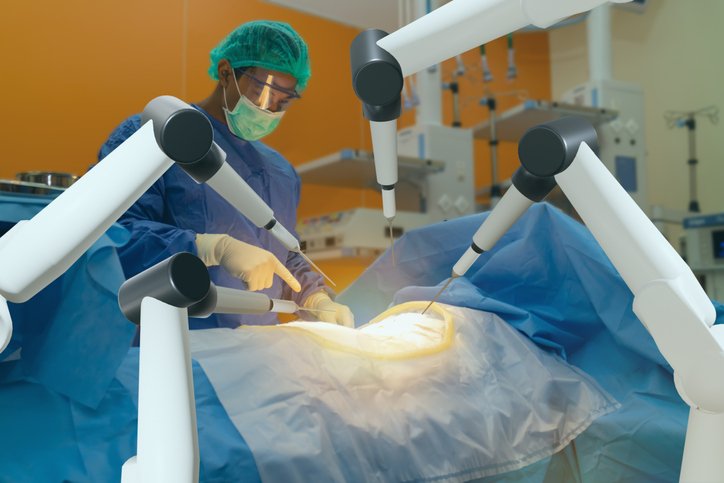
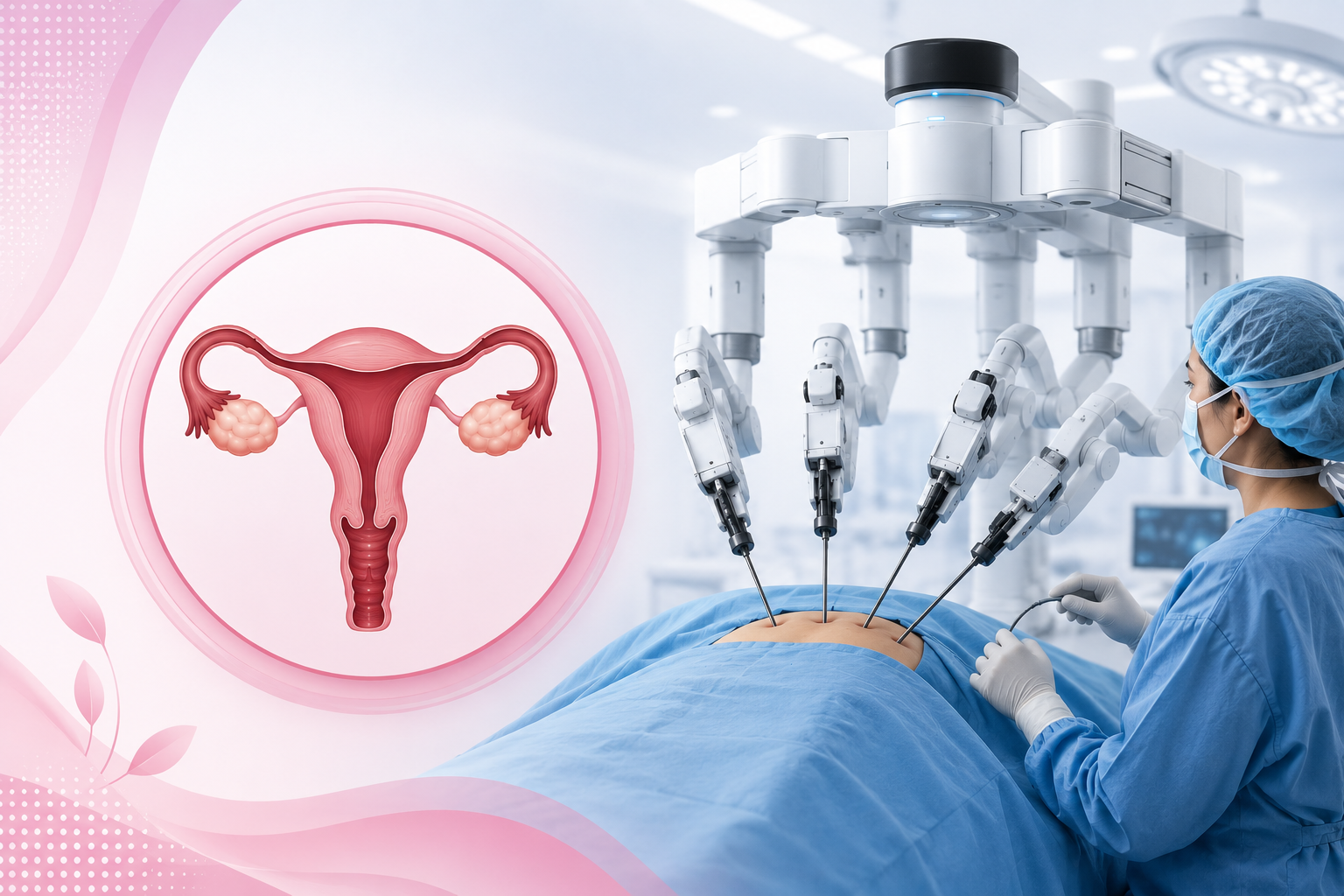
Robotic-assisted laparoscopic hysterectomy (RALH) uses the da Vinci or similar robotic system to provide the surgeon with a 3D high-definition view and instruments with greater range of motion than standard laparoscopy. This is particularly advantageous for complex cases — large uteri, extensive adhesions, previous pelvic surgery, or obesity — where standard laparoscopy may be difficult.
Robotic vs Laparoscopic vs Open: Key Differences
- Hospital stay: Open: 5–7 days | Laparoscopic: 1–2 days | Robotic: 1–2 days
- Recovery time: Open: 6–8 weeks | Laparoscopic: 2–3 weeks | Robotic: 2–3 weeks
- Blood loss: Open: Highest | Laparoscopic: Lower | Robotic: Lowest
- Scar size: Open: 10–15 cm | Laparoscopic: 3–4 small ports | Robotic: 3–4 small ports
- Complication rates: Open: Higher | Laparoscopic: Lower | Robotic: Comparable or slightly lower for complex cases
- Surgeon precision: Open: Good | Laparoscopic: Good | Robotic: Excellent, especially in restricted spaces
Which Approach Is Best for You?
The optimal surgical approach depends on the size and condition of your uterus, your BMI, your surgical history, the indication for surgery, and your surgeon’s expertise. Dr. Mendiratta will discuss all options and recommend the approach that offers the best balance of safety, efficacy, and recovery for your specific situation.
The most important factor in the success of any hysterectomy — open, laparoscopic, or robotic — is surgeon experience. Dr. Mendiratta has performed hundreds of minimal-access hysterectomies and brings the same precision and attention to each procedure.
Recovery After Robotic/Laparoscopic Hysterectomy
- Day 1–2: In hospital; walking the day after surgery
- Week 1–2: Resting at home; light activity permitted
- Week 3–4: Returning to desk work and light household duties
- Week 6: Most women have returned to full normal activity, including exercise
- No vaginal intercourse for 6–8 weeks after any type of hysterectomy
Risks of Hysterectomy
All surgery carries risks. For robotic/laparoscopic hysterectomy, these include:
- Bleeding (rare, occasionally requiring transfusion)
- Infection (reduced compared to open surgery)
- Injury to adjacent structures (ureter, bladder, bowel) — very rare in experienced hands
- Anaesthetic complications
- Deep vein thrombosis (prevented by early mobilisation and compression stockings)
Serious complications are uncommon when surgery is performed by an experienced minimal-access surgeon. Dr. Mendiratta will discuss all risks with you in detail at your pre-operative consultation.
Frequently Asked Questions (FAQs)
Q1. Will I go into menopause after hysterectomy?
Only if your ovaries are removed at the same time (bilateral oophorectomy). If your ovaries are preserved — which is the standard approach for benign conditions in younger women — you will not experience surgical menopause.
Q2. Can I have a robotic hysterectomy even if I am overweight?
Yes. Robotic surgery is often preferred for women with higher BMI because the robotic system provides better access and visualisation in a deeper pelvis. Discuss this with Dr. Mendiratta during your consultation.
Q3. How long does a robotic hysterectomy take?
Typically 1.5–3 hours depending on the complexity of the case.
Q4. Will my sex life change after hysterectomy?
Most women report no change or even improvement in their sex life after hysterectomy, particularly if the procedure relieved pain, bleeding, or pressure. Vaginal length is preserved in all standard hysterectomy techniques.
Q5. How do I know if I need a total vs subtotal hysterectomy?
A total hysterectomy removes the uterus and cervix. A subtotal (supracervical) hysterectomy removes the uterus but leaves the cervix. The decision depends on several factors including the indication for surgery. Dr. Mendiratta will explain which is most appropriate for you.
Get In Touch With Dr. Shweta Mendiratta
Phone: +91-8130048652 | +91-9999093503
Email: shwetasmendiratta@gmail.com
Yatharth Super Speciality Hospital
Plot No 9, Sector-20, Krishna Nagar, New Industrial Township, Faridabad, Haryana 121007
Phone: +91 8178-939442
Mediclub Gynae ‘N’ Neuro Clinic
Pilot No. 857 Sector 21 C, Faridabad Delhi, Haryana 121001