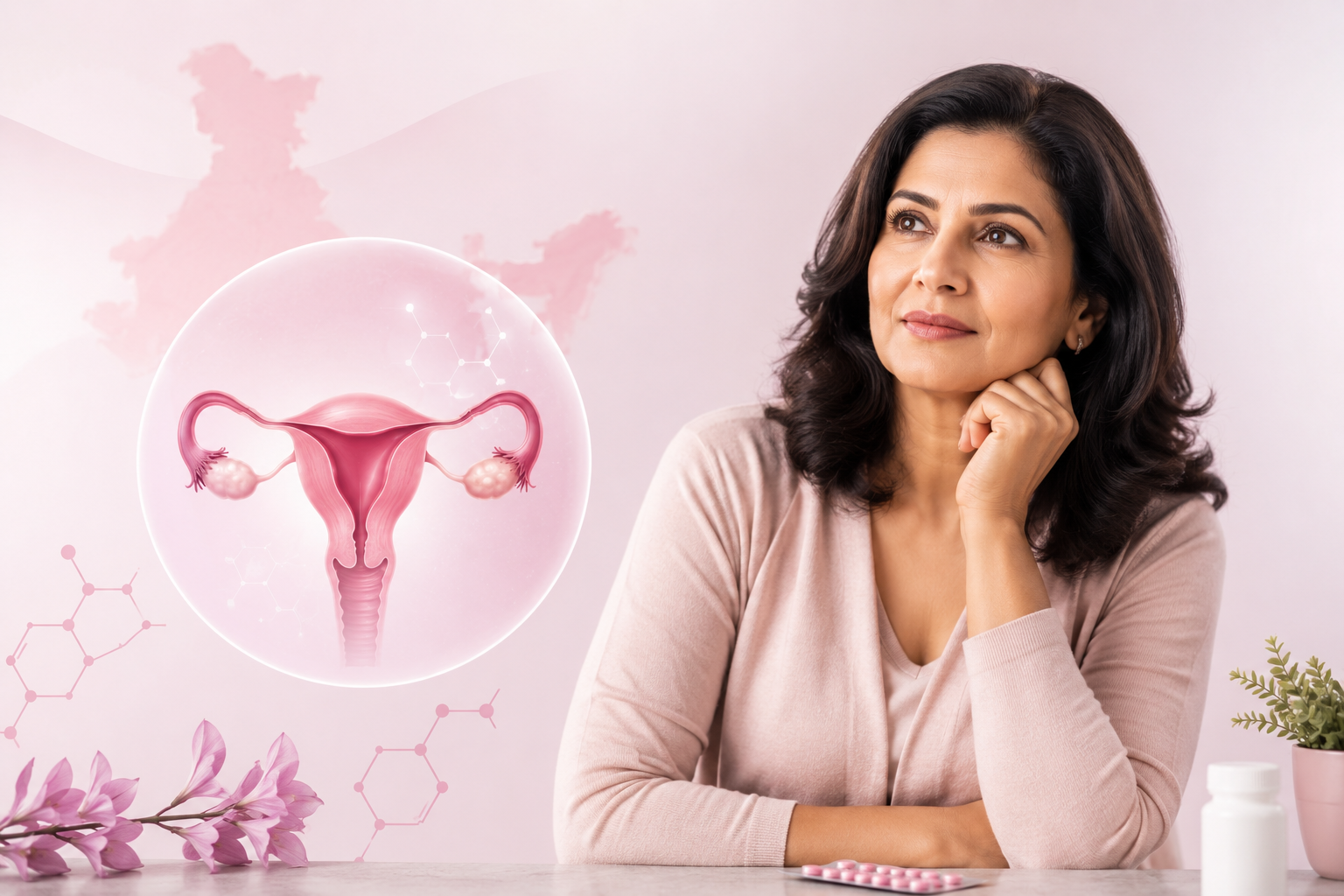
Few medical topics have been more misunderstood, more feared, and more under-prescribed in India than hormone replacement therapy (HRT). A study published in 2002 sent women and their doctors into panic — and its flaws and subsequent corrections were never communicated with the same urgency as the original alarm. Two decades later, the science on HRT has been thoroughly re-evaluated. The result is reassuring: for most healthy women under 60 who begin HRT within 10 years of menopause, the benefits substantially outweigh the risks. Dr. Shweta Mendiratta, top gynecologist in Faridabad, provides a clear, evidence-based guide.
What Is HRT?
Hormone replacement therapy replaces the oestrogen (and where applicable, progesterone) that the ovaries stop producing at menopause. It is used to:
- Relieve menopausal symptoms (hot flushes, night sweats, sleep disturbances, mood changes, vaginal dryness)
- Protect bone density and reduce fracture risk
- Reduce cardiovascular risk when started early in the menopause transition
- Improve quality of life, cognitive function, and sexual health
Types of HRT Available in India
By Hormone Type
- Oestrogen-only HRT: For women who have had a hysterectomy and have no uterus
- Combined HRT (oestrogen + progestogen): For women with an intact uterus; the progestogen protects the uterine lining from the effects of unopposed oestrogen
- Body-identical HRT: Uses micronised progesterone (identical in structure to natural progesterone) combined with oestradiol — associated with a lower risk profile than older synthetic progestogens
By Route of Administration
- Oral tablets: Convenient but undergo first-pass metabolism in the liver
- Transdermal patches: Applied to the skin twice weekly; bypass liver metabolism; lower risk of blood clots
- Gels: Oestrogen gel applied daily to the skin; excellent alternative for women who dislike patches
- Vaginal oestrogen (cream, pessary, ring): For local genitourinary symptoms only; negligible systemic absorption
Transdermal and vaginal oestrogen routes are increasingly preferred because they avoid first-pass hepatic metabolism and carry a lower risk of venous thromboembolism (blood clots) compared to oral oestrogen.
The Benefits of HRT — What the Evidence Shows
Symptom Relief
HRT is the most effective treatment for vasomotor symptoms (hot flushes and night sweats), with reduction rates of 75–90%. It is also highly effective for vaginal dryness, sleep disruption, mood changes, and joint pain associated with menopause.
Bone Protection
Oestrogen is the primary regulator of bone turnover in women. HRT reduces the rate of bone loss, prevents osteoporosis, and significantly reduces the risk of hip and vertebral fractures. It is particularly important for women who reach menopause before age 45.
Cardiovascular Health
When started within 10 years of menopause (the ‘window of opportunity’), oestrogen has beneficial effects on the cardiovascular system — improving lipid profiles, reducing arterial stiffness, and potentially reducing the risk of coronary heart disease. Women who begin HRT close to menopause appear to have a reduced risk of cardiovascular events compared to women who delay or never use HRT.
Cognitive Function
Oestrogen plays a role in brain function and neuroprotection. Emerging evidence suggests that HRT started early in the menopause transition may reduce the risk of Alzheimer’s disease, though this remains an area of active research.
The Risks of HRT — Understanding the Real Numbers
Breast Cancer
The most feared risk associated with HRT is breast cancer. The picture is nuanced:
- Oestrogen-only HRT (for women without a uterus) is not associated with a significantly increased breast cancer risk and may even be associated with a slight reduction in risk
- Combined HRT (oestrogen + synthetic progestogen) is associated with a small increased risk — approximately 4 extra cases per 1000 women over 5 years of use
- Body-identical HRT using micronised progesterone appears to carry a lower breast cancer risk than synthetic progestogen combinations
- The excess risk is comparable to that from drinking one to two glasses of alcohol per day or being overweight
- Breast cancer risk returns to baseline within 5 years of stopping HRT
Blood Clots (VTE)
Oral oestrogen doubles the baseline risk of venous thromboembolism (DVT/PE). However, transdermal oestrogen does not increase VTE risk — a crucial distinction. For women at increased VTE risk, transdermal HRT is the preferred route.
Stroke
Oral oestrogen is associated with a small increase in ischaemic stroke risk; transdermal oestrogen is not. Again, route of administration matters significantly.
Who Should Consider HRT?
HRT is appropriate for:
- Women with significant menopausal symptoms affecting quality of life
- Women with premature ovarian insufficiency (POI) or early menopause — HRT is essential for bone and cardiovascular protection and should be continued until the natural age of menopause
- Women with osteoporosis or high fracture risk
- Women who have failed or prefer not to use non-hormonal alternatives for symptom management
Who Should Not Use HRT?
- Women with current or recent hormone receptor-positive breast cancer (oestrogen-sensitive)
- Women with unexplained vaginal bleeding
- Women with active thromboembolism (DVT or PE)
- Women with severe liver disease
Note that a history of cardiovascular disease, migraine with aura, or controlled hypertension is not an absolute contraindication to HRT — the route, type, and dose can be adjusted. Dr. Mendiratta conducts a thorough risk assessment before prescribing.
HRT in India: Availability and Cost
Several HRT preparations are available in India, including oral oestradiol and combined preparations. Transdermal patches and gels are increasingly available in urban pharmacies, though access varies. Body-identical micronised progesterone is available. Dr. Mendiratta can advise on the most appropriate formulation for your needs and budget.
Frequently Asked Questions (FAQs)
Q1. How long can I take HRT?
There is no arbitrary maximum duration. HRT should be used for as long as you need it and the benefits outweigh the risks for you individually. An annual review with your doctor is recommended. Many women use HRT safely for 5–10 years or longer.
Q2. Will I gain weight on HRT?
Menopause itself causes weight gain — particularly abdominal fat — due to falling oestrogen. HRT may actually mitigate this effect. Clinical studies do not consistently show that HRT causes weight gain beyond what is expected in the menopause transition.
Q3. Can I start HRT 10 years after menopause?
Starting HRT more than 10 years after menopause or after age 60 is more complex. The cardiovascular and cognitive benefits are less certain and there may be a slightly higher risk of cardiovascular events. This needs to be assessed individually.
Q4. Is HRT available over the counter in India?
HRT is a prescription medication in India and should only be initiated under medical supervision after a full assessment of your health history, risk factors, and symptom profile.
Q5. What is bio-identical HRT and is it better?
‘Bio-identical’ refers to hormones that are structurally identical to those produced by the body (oestradiol and micronised progesterone). These are available as regulated pharmaceutical preparations and are generally preferred over compounded alternatives. They appear to carry a more favourable safety profile, particularly regarding breast cancer risk, than older synthetic progestogens.
Get In Touch With Dr. Shweta Mendiratta
Phone: +91-8130048652 | +91-9999093503
Email: shwetasmendiratta@gmail.com
Yatharth Super Speciality Hospital
Plot No 9, Sector-20, Krishna Nagar, New Industrial Township, Faridabad, Haryana 121007
Phone: +91 8178-939442
Mediclub Gynae ‘N’ Neuro Clinic
Plot No. 857 Sector 21 C, Faridabad Delhi, Haryana 121001